Quick Rundown
WW2 strategy games cover a wider range of scales than any other historical genre. At one end, you’re managing a nation’s entire war economy across eight years of simulation, tracking production queues, diplomatic pressure, and supply lines across multiple continents. At the other end, you’re directing eight soldiers across a farmhouse yard in Normandy, and the specific tree line they used for cover matters. The best WW2 strategy games aren’t the same game at different resolutions. They’re different disciplines.
This list is organized by scale. Grand strategy first, then operational, then tactical. Whatever level of abstraction fits the way you think about the war, there’s a game here built for it.
Hearts of Iron IV: Grand Strategy at Full Scope

Hearts of Iron IV remains the benchmark for WW2 grand strategy, and nothing released since has seriously challenged it at that scale. You control any nation on the globe from 1936 onward, managing national focus trees, diplomatic relationships, production queues, research priorities, division designs, and the strategic deployment of armies across multiple fronts at the same time.
The complexity is the point. A player who understands how to optimize a division template, when to commit to a front and when to hold, and how to structure an air force for close ground support will achieve outcomes dramatically different from one who doesn’t. That skill ceiling is what keeps the game’s community active years after launch and through multiple major DLC expansions.
Players new to the genre will find it steep. The grand strategy beginner’s guide covers the core frameworks before committing to HoI4’s full complexity. The investment pays off, but context helps.
Steel Division 2: Operational Warfare on the Eastern Front

Steel Division 2 sits between grand strategy and pure tactical play. It’s a real-time strategy game set primarily during the 1944 Soviet offensive operations in Belorussia, featuring both an operational campaign layer where you maneuver divisions across a theater map and real-time battles fought at company and battalion scale.
The historical fidelity is high. Unit rosters, performance characteristics, and operational contexts are researched in detail. The game’s campaign structure generates engagements that reflect actual historical dynamics of the Eastern Front rather than generic skirmish setups. For players who want a WW2 strategy game that takes its source material seriously at the operational level, Steel Division 2 is the clearest option available.
If you’re coming to it from other real-time strategy games, the best real-time strategy games roundup covers the genre’s current landscape and puts Steel Division 2 in useful comparative context.
Company of Heroes 3: The Best Entry Point for Tactical RTS

Company of Heroes 3 is the most accessible game on this list, and it doesn’t sacrifice depth to get there. The Italy campaign operates as a dynamic strategic sandbox built on a Total War-style overworld. You manage division positioning, resource captures, and reinforcement decisions at the operational level, then drop into real-time tactical battles when fronts make contact.
The tactical layer is where the series earned its reputation, and Company of Heroes 3 maintains it. Cover is a real mechanic. Suppression affects how units can move and fight. Combined arms, using tanks and infantry together rather than treating them as separate tools, determines outcomes in contested engagements. It’s a game that teaches WW2 tactical doctrine through play rather than explanation.
Company of Heroes 3 holds up against anything currently available in the WW2 tactical RTS space and is covered in the war strategy games breakdown alongside other strong titles in the genre.
Combat Mission: Battle for Normandy — Simulation for the Serious

Combat Mission: Battle for Normandy uses a WEGO system where both sides issue orders simultaneously and then a 60-second execution phase plays out in real time. The result is tactical combat that feels less like a chess match and more like actual small-unit operations. Line of sight is calculated per soldier. Suppression degrades decision-making at the squad level. Vehicle armor values vary by facing angle and range.
This is the game for players who want to understand how WW2 tactical operations actually worked, not how they’ve been simplified for general audiences. It doesn’t have the production values of Company of Heroes or the multiplayer community of Steel Division, but for players who care about accuracy over accessibility, nothing on this list gets closer to simulation. Combat Mission has had approximately zero marketing budget and has been quietly correct about WW2 tactical modeling for two decades. Those two facts are probably related.
Order of Battle: WW2 — Turn-Based Operational Play

Order of Battle: WW2 fills a gap the other games here leave open: turn-based operational strategy across multiple theatres. The game’s campaign series covers the Pacific, North Africa, Western Europe, and the Eastern Front, each with distinct unit rosters and campaign structures. The turn-based format makes it more accessible than Steel Division 2’s real-time demands and more focused than HoI4’s macro scope.
For players who want to work through WW2 operations at the corps and army level but prefer deliberate turns over real-time execution pressure, Order of Battle fills that specific niche well. It’s consistently underrated in genre discussions, given what it offers at its price point.
Strategic Command WWII: World at War
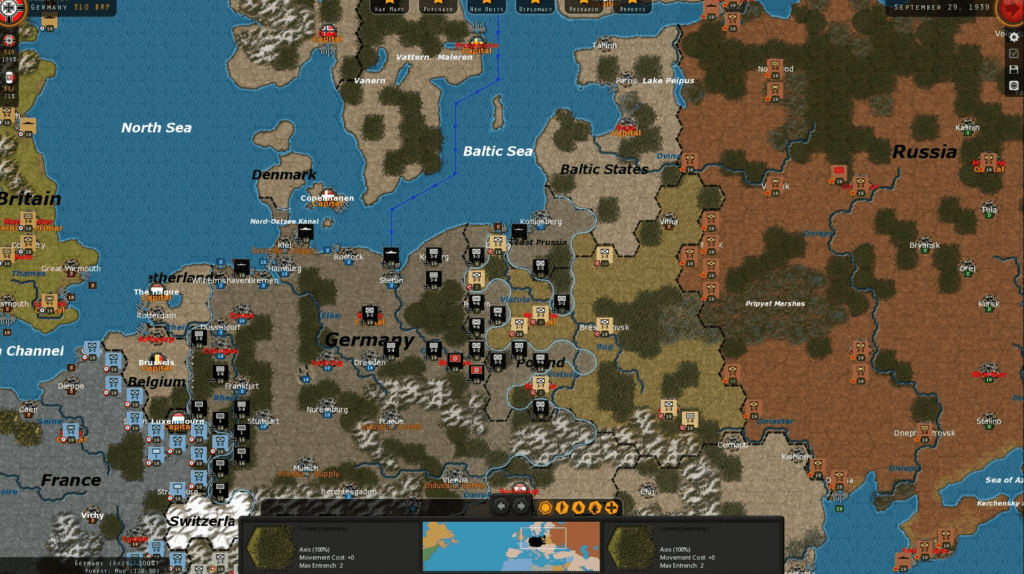
If Hearts of Iron IV is the learn-it-for-two-months option, Strategic Command WWII is the one you can actually finish. Fury Software’s series keeps the grand-strategic scope: you’re managing diplomacy, research, and theater-level operations across every front. But it removes the administrative complexity that drives new players away from Paradox titles.
The hex-based turn structure makes it feel closer to classic wargaming than to modern grand strategy. Decisions are clean. The AI plays competently. You can complete a full campaign without consulting a wiki to understand why your naval doctrine bonuses aren’t applying correctly. That accessibility matters because the underlying historical model is solid. The timing of Lend-Lease, the conditions for US entry, and the Axis over-extension in North Africa hit in roughly the right years for the right reasons.
Cultured Vultures’ WW2 strategy comparison notes that Strategic Command holds up well for players who want historical accuracy without the steep learning curve of the Paradox ecosystem. Players who want to understand the broader historical strategy genre context should explore our historical strategy games guide.
Developer: Fury Software / Slitherine. Platform: PC. Verdict: The most accessible grand-strategic WW2 game that doesn’t sacrifice historical grounding.
Unity of Command II
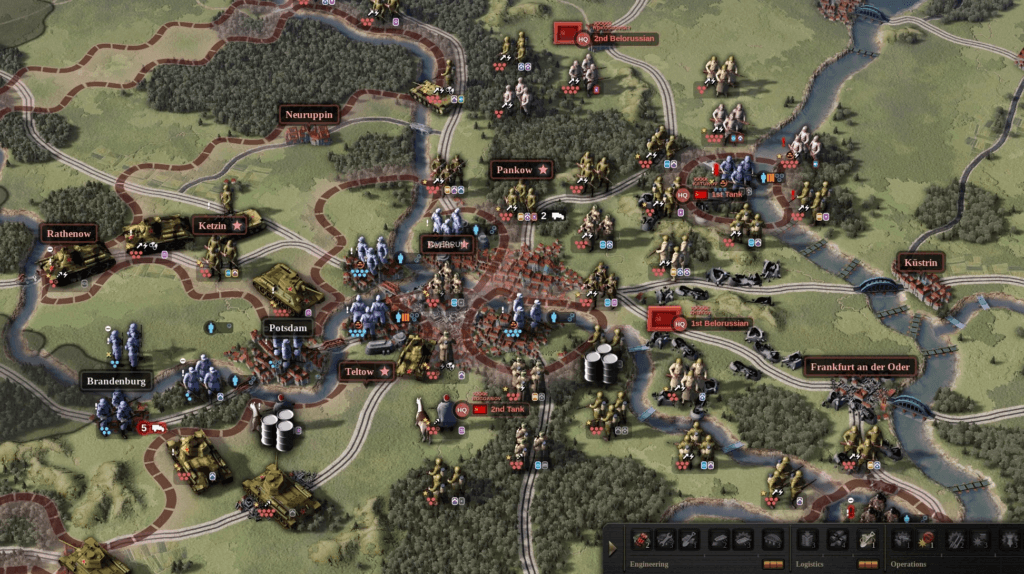
Most WW2 strategy games handle the operational level poorly. Unity of Command II handles it better than anything else in the genre. 2×2 Games released it in 2019 with a deliberately narrow focus: Allied ground operations from North Africa through the liberation of Western Europe, with an Eastern Front expansion adding the Soviet campaigns.
The supply system is the game’s defining mechanic. Cutting an enemy formation off from its supply lines doesn’t just reduce its effectiveness. It collapses the unit, which mirrors how WW2 operational campaigns actually worked. The Falaise Pocket, the Allied logistics crisis after Normandy’s breakout, the challenge of sustaining armored spearheads during rapid advances across France: Unity of Command II models these constraints in ways that are accessible without reducing them to abstraction.
The Schwerpunkt doctrine is a mechanical reality here. Concentrating force at a decisive point, exploiting the gap, protecting the flanks of your advance: the things that made German operational commanders effective in 1941 are the same things that win campaigns in this game. GameWatcher’s WW2 strategy overview identifies the supply model as one of the most historically coherent in the genre. It sits comfortably within our coverage of war strategy games across historical settings.
A full campaign runs 20 to 30 hours, which puts it well ahead of most serious wargames for players who want historical depth without an open-ended time commitment.
Developer: 2×2 Games. Platform: PC (Steam). Verdict: The best operational-level WW2 game for players who want to finish what they start.
Gary Grigsby’s War in the East 2
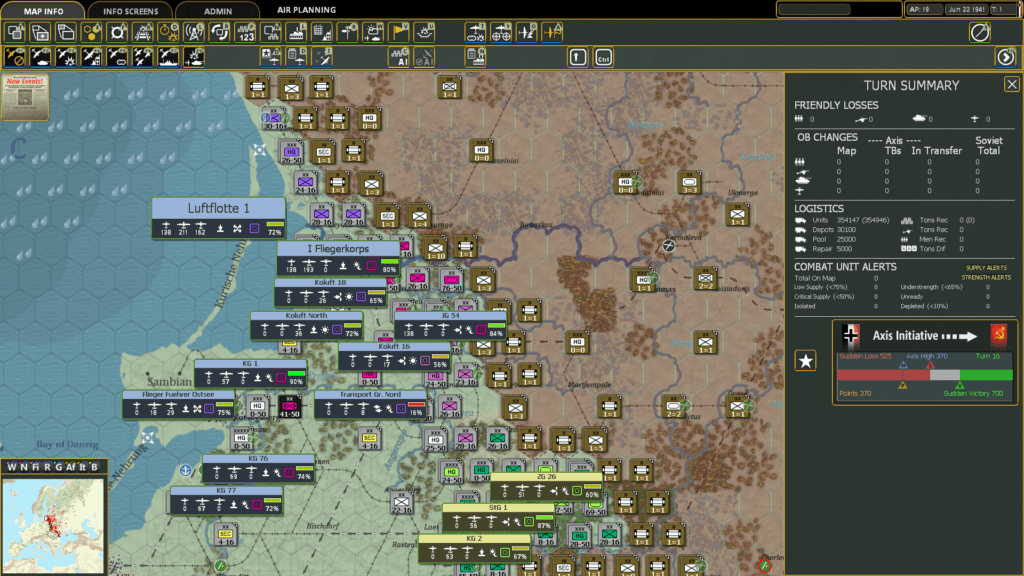
This section requires a disclosure. Gary Grigsby’s War in the East 2 is not a casual pickup. It is a 2021 operational and strategic simulation of the Eastern Front, from Barbarossa to the Soviet advance on Berlin, that models the war at a level no other PC title approaches. The manual exceeds 300 pages. Community veteran guides run longer. Budget 30 hours before you understand the interface well enough to make meaningful strategic decisions.
The unit scale covers divisions and corps. The supply model tracks fuel, ammunition, and replacement personnel on separate tracks. The air war runs on an independent layer that interacts with ground operations directly. Weather affects movement rates and air operations by season and region. The historical research behind it is visible in the mechanics: German operational tempo in 1941 and 1942, the Soviet transition from catastrophic encirclements to mastery of deep battle doctrine by 1943 and 1944, and the Wehrmacht logistical collapse in the war’s final year are all present in how the game plays, not just in scenario flavor text.
Strategy and Wargaming’s look at the decade’s top wargames places it at the peak of the simulation tier, and that assessment is accurate. For players at the deep end of the spectrum, our military strategy games coverage surfaces additional titles worth exploring once you’ve worked through the Eastern Front campaigns.
It is actively hostile to newcomers. For the player who’s ready for it, nothing in the genre competes.
Developer: 2by3 Games / Slitherine. Platform: PC. Verdict: The most historically rigorous WW2 simulation available, and the most demanding.
Picking Your Scale
The most common mistake is choosing the wrong abstraction level. Players who want to understand what WW2 felt like from the perspective of national leadership belong in Hearts of Iron IV. Players who want to understand what a company commander faced in Normandy should start with Company of Heroes 3 and move to Combat Mission when they’re ready for higher fidelity.
- National/grand scale: Hearts of Iron IV
- Operational scale: Steel Division 2, Order of Battle: WW2
- Tactical RTS: Company of Heroes 3
- Tactical simulation: Combat Mission: Battle for Normandy
Most dedicated strategy players end up across multiple tiers of this spectrum because they’re asking different questions about the same war. Strategygame.org covers WW2 and historical strategy across all of these scales.
The best strategy games of all time list puts several of these titles in longer historical perspective.
For more WW2 and historical strategy picks sorted by subgenre, the rankings section has them organized by format and complexity.
