Quick Rundown
New RTS games had a rough decade between 2010 and 2023. The genre that gave us StarCraft, Age of Empires, and Command and Conquer spent years producing disappointing sequels and free-to-play experiments that felt like MOBAs in denial. Something shifted around 2024. Tempest Rising shipped as a polished, complete product. Beyond All Reason built a real community with no monetization whatsoever. Stormgate arrived from StarCraft II veterans with serious backing. Battle Aces proposed a faster, deck-focused take on the formula. ZeroSpace announced the most ambitious RTS concept in years. This ranking covers the current state of each, with honest calls on what works, what doesn’t, and what’s still coming together.
For broader genre context, our RTS genre guide covers the history from Dune II to the current generation. And for how today’s releases compare to the all-time classics, our best strategy games of all time puts the current crop in full perspective.
The Ranked Picks
1. Tempest Rising — The One That Actually Shipped
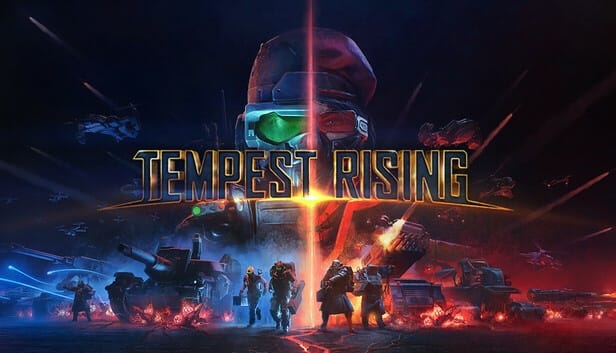
If you’ve been waiting for an RTS that proves the genre can still produce polished, finished games, Tempest Rising is the answer. Slipgate Ironworks built it to evoke Command and Conquer without being a clone: three factions with genuine asymmetry in the Global Defense Force, Tempest Dynasty, and the Myriad; an alternate-history 1990s Cold War setting where a mysterious green energy source reshaped geopolitics; and a campaign with actual production values and varied mission objectives.
What separates it from its inspirations is the unit veterancy system, which creates real choices about protecting experienced squads versus spending them for tactical gains. The resource model is familiar without being identical to classic C&C: two resources, with the secondary requiring more deliberate base planning. Campaign missions vary their objectives rather than running the “build a base and destroy everything” template that plagued mid-era Command and Conquer titles. It launched feature-complete with no early access disclaimer. In 2025, that’s rarer than it should be.
Current state: Fully released. Active with patches and community.
Play this if you liked: Command and Conquer: Red Alert 2, Grey Goo, StarCraft II.
2. Beyond All Reason — Free, Massive, and Underrated
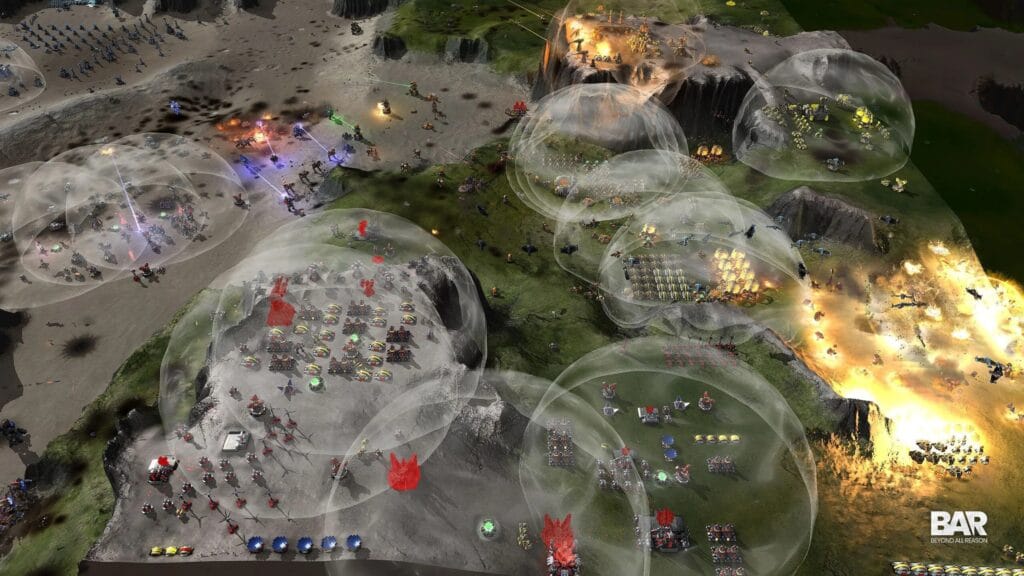
Beyond All Reason is the RTS most players haven’t tried, and the one most likely to consume a hundred hours if they do. It’s a free, open-source game built on the Spring engine, handling battles with thousands of units across maps large enough that satellite views become necessary. The economy scales in ways traditional RTS games don’t attempt: early-game skirmishes give way to mid-game factory chains and late-game attacks that look more like natural disasters than tactical engagements.
The learning curve is real and the interface is dense. But the active development community has kept it growing for years without any monetization. For players who miss the scale of Total Annihilation or Supreme Commander, Beyond All Reason is the best available option. Our best strategy games on Steam guide covers it in the broader context, but it warrants a specific callout here: the community is active, the game is free, and nothing else in the current RTS field operates at this scale.
Current state: Free, ongoing development, active multiplayer community.
Play this if you liked: Total Annihilation, Supreme Commander, Spring: 1944.
3. Stormgate — Still Finding Its Footing
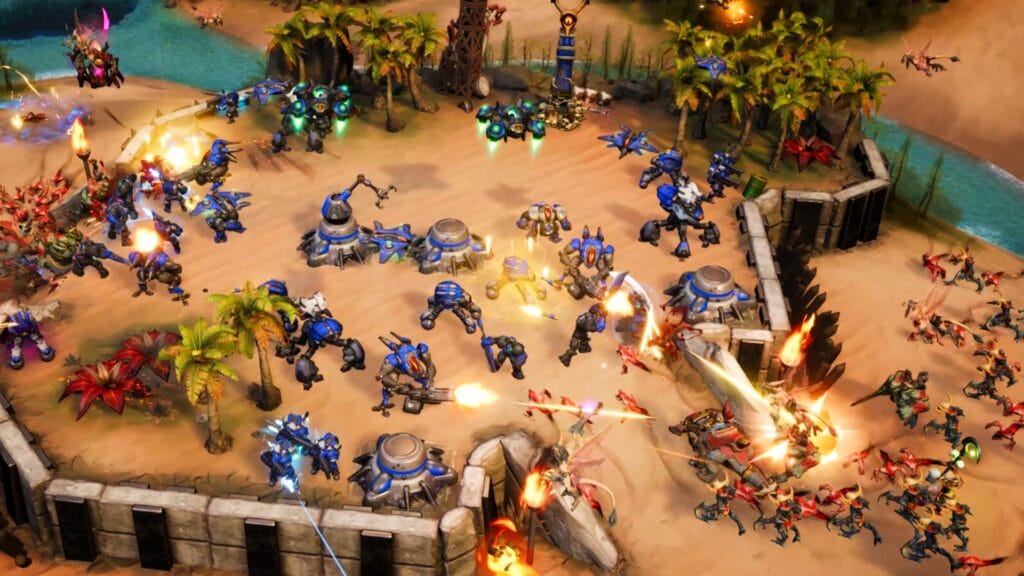
Stormgate arrived from Frost Giant Studios, founded by Tim Morten (StarCraft II: Legacy of the Void production director) and Tim Campbell (Warcraft III lead campaign designer). The pedigree created real expectations. The early access release created complicated feelings.
The core RTS mechanics are solid: three factions, real-time base-building, a campaign that launched with the Ashes of Earth chapter. The free-to-play model is a reasonable approach to keeping the playerbase accessible. The issue has been retention: the initial player spike dropped faster than Frost Giant hoped, and mid-game army engagement has been cited by competitive players as less distinctive than StarCraft’s rock-paper-scissors faction dynamics. Patches have addressed several early criticisms, including unit responsiveness and battle readability. The campaign layer received stronger reviews than the early multiplayer implementation. It’s a serious RTS from credible developers, not a cynical cash-in. Give it another few patches before fully committing.
Current state: F2P early access, actively updated.
Play this if you liked: StarCraft II, Warcraft III.
4. Battle Aces — The Fastest Take on the Formula
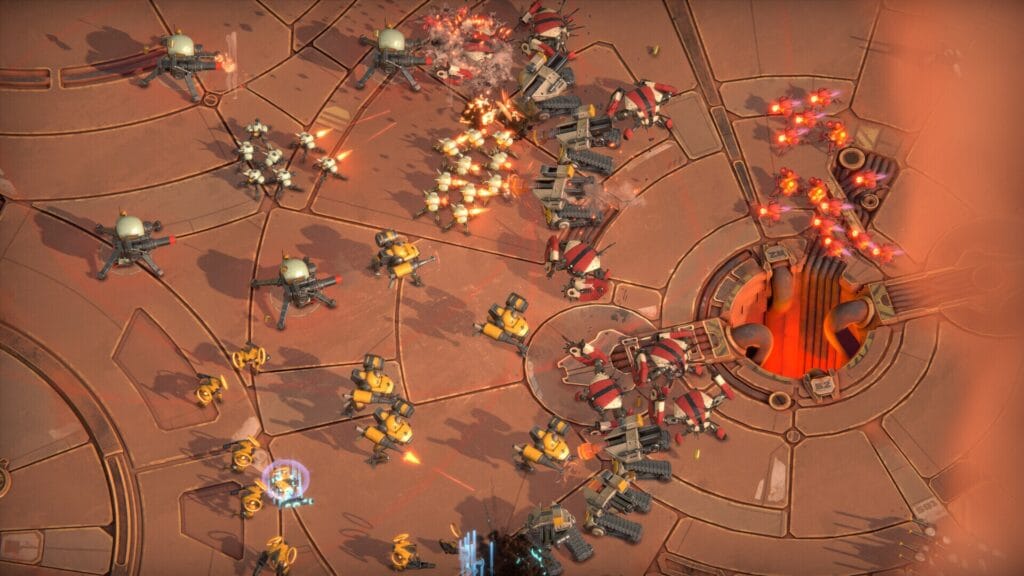
Battle Aces compresses the traditional RTS into shorter, faster matches where unit composition and micro execution matter immediately. Developed by Uncapped Games (veterans from Blizzard and other studios), it introduces a deck-building element that lets you pre-select which units you’ll field before each match, adding a strategic layer that typically lives outside the game in the lobby meta.
Whether this feels energizing or reductive depends entirely on what you value in an RTS. For players who bounced off StarCraft because a full match takes too long, Battle Aces is the genre adapted for that preference. For players who love macro economy management and the slow build to critical mass, it won’t satisfy. It’s not the RTS the war strategy crowd has been asking for, but it’s a legitimately interesting design proposition for the competitive end of the player base.
Current state: Released with active updates.
Play this if you liked: StarCraft II (multiplayer focus), Clash Royale (if you want that speed applied to an RTS framework).
5. ZeroSpace — The Long Game
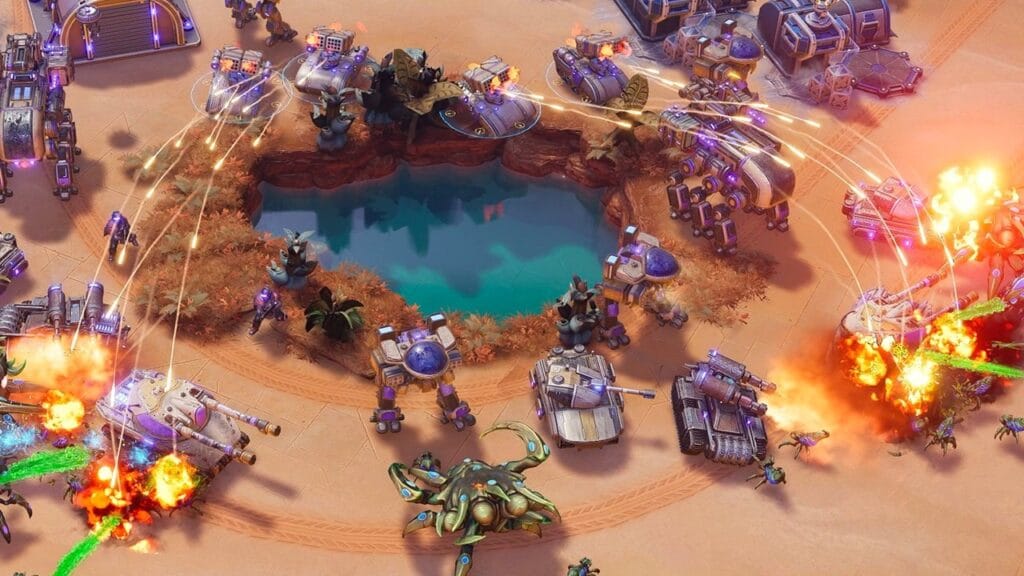
ZeroSpace by Starlance Studios is the most ambitious RTS in active development and the hardest to evaluate because it isn’t finished yet. The premise: a shared, persistent MMO galaxy map where all game modes — single-player campaign, co-op, PvE, and competitive PvP — exist in the same living world. Territory control persists across sessions. Player decisions affect the faction balance at a macro level. Think PlanetSide 2 meets StarCraft, running continuously.
The campaign scope is staggering on paper: 13 main story missions, 14 hero loyalty missions, and 40 side arcs with choice-driven branching across four factions. Whether Starlance can deliver on all of it is genuinely uncertain. But the ambition is real, not just marketing language. ZeroSpace is a long-term bet on an RTS concept that hasn’t been attempted at this scale. The current build is playable, and the foundation is there. Check back at full release to know if the bet paid off.
Current state: In development, available on Steam in early form.
Play this if you liked: StarCraft II, PlanetSide 2 (for the persistent-world angle).
The Bigger Picture
The new RTS strategy games arriving in 2025 and 2026 each have a different theory about what the genre needs. Tempest Rising argues it needs polish and completion at launch. Beyond All Reason argues it needs scale and accessibility through free pricing. Stormgate argues it needs the StarCraft audience brought into a modern F2P model. Battle Aces argues it needs to be faster and competition-match friendly. ZeroSpace argues it needs to be larger and more persistent than any RTS has attempted.
None of them agree on the answer, which is a good sign. Genre stagnation comes from consensus. A decade where every RTS tried to be a lighter, more casual experience led to the genre’s rough period. This much disagreement about direction points to real creative energy returning, and for players who’ve been waiting for the RTS to recover its ambition, 2025 and 2026 have delivered more reasons for optimism than any two-year stretch since 2010.
For the best RTS games across new releases and the genre’s full catalog, that list covers the complete picture. Our military strategy coverage goes deeper on games where tactical simulation takes precedence over base-building. Strategygame.org tracks new RTS releases as they arrive. The real-time strategy guides section is where the genre-specific deep dives and individual game coverage live. For overall strategy game rankings across every subgenre, that section is updated as significant new releases land.
