
Risk game strategies are a genuinely interesting subject because Risk looks like a luck game and isn’t. Dice control outcomes on individual battles, but the decisions about where to attack, which continent to hold, when to cash cards, and how to manage alliances are all skill. Players who understand that distinction win consistently. Players who don’t blame the dice and lose again next time. This guide covers the decisions that actually separate winners from losers in classic Risk: territory priorities, the math behind attacks and defense, card strategy, alliance timing, and how to close a game before someone else does it first.
Continent Priority: Which Ones Are Worth Holding
The continent bonuses — extra armies awarded each turn for controlling a full continent — are Risk’s primary economic lever. The question is which continents are worth the troops required to hold them.
Australia is the most defensible starting position in Risk. One entry point (Siam) means you only need to hold one border. The bonus is small (2 armies per turn), but the low troop cost to defend makes it efficient. Most experienced players treat controlling Australia as table stakes for a winning position.
South America is the second-best starting continent. Two entry points (Venezuela and Brazil) are manageable, and the bonus (2 armies) is equivalent to Australia. The exposure to North America through Venezuela makes it slightly riskier than Australia, but it’s faster to secure if you start with South American territories.
North America is significantly more valuable (5 armies per turn) but has three entry points and a much larger territory footprint to control. Worth pursuing once you have a smaller continent secured, not as an opening gambit.
Africa offers 3 armies per turn with three border territories — better value than the small continents, but central enough on the board that everyone passes through it. Hard to hold for long without consistent reinforcement.
Europe and Asia have the highest bonuses (5 and 7 armies respectively) and the most entry points. Europe has four borders and a central position that makes it a target from all directions. Asia requires a massive territory commitment and is essentially indefensible in a competitive game. Neither is a first-continent target. For players interested in how continent control concepts translate to digital formats, our war strategy games guide covers titles where territory control and area denial play similar roles.
The Attack and Defense Math
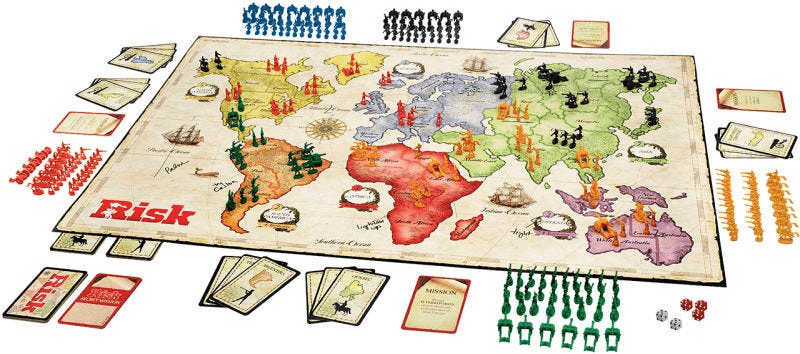
Risk combat runs on dice probabilities, and understanding the odds changes how you attack and when you stop.
When the attacker rolls three dice against the defender’s two, the attacker wins both dice matchups roughly 37% of the time, the defender wins both about 45% of the time, and each side loses one roughly 32% of the time. This means that in a straight exchange of equal armies, the defender has a statistical edge. Attack when you have a significant numerical advantage — 3:1 or better — not because the dice will necessarily favor you, but because you can absorb losses and still take the territory.
The most common mistake in Risk is overextending after a successful attack. Taking five territories in one turn looks impressive and leaves you with two armies on each of them. A player who consolidates, reinforces borders, and moves deliberately will usually outlast a player who pushes for maximum expansion.
Holding one army on interior territories and stacking armies on border territories is the correct distribution. Interior territories don’t need defenders — they’re not being attacked. Every army on an interior territory is an army not reinforcing a border that matters.
How to Use Alliances Without Getting Burned

Risk rewards alliance building and punishes alliance overextension in equal measure. The player who can’t make alliances gets eliminated early. The player who relies on alliances too long gets backstabbed at exactly the wrong moment.
Alliances are most valuable in the early game when eliminating any individual threat is less important than collective survival. If two players agree not to attack each other across a shared border, both can focus troops elsewhere. This creates real value — the agreement frees armies for offensive use instead of defensive positioning.
The danger is treating alliances as permanent. Every agreement in Risk has an expiration date: roughly the point where eliminating your ally becomes profitable. The player who recognizes that moment — and acts on it before their ally does — wins the exchange. The player who trusts the alliance past its useful life gets eliminated instead.
Don’t telegraph your intentions. If you’re planning to break an alliance, don’t reinforce the shared border conspicuously for three turns. Move normally, then strike when you have the troop advantage and the card hand to capitalize. For a deeper look at how territory and alliance dynamics play out in comparable tabletop formats, the tabletop strategy games guide covers games where negotiation and area control intersect in similar ways.
Card Strategy and the Escalating Set Value
Risk cards are among the most underappreciated elements in the game. Each time you capture at least one territory during your turn, you earn one card. Collect a matching set of three (infantry, cavalry, artillery, or one of each) and you can trade them in at the start of your turn for bonus armies. The critical detail: set values increase as the game progresses. The first set cashed in gets you 4 armies, and the value escalates to 6, 8, 10, 12, 15, and then 5 more armies per set after that. Late-game card sets are worth dramatically more than early ones.
This creates a meaningful strategic tension. Cashing cards early gets you armies now but locks in low values. Holding cards longer builds toward higher-value sets — but every turn you wait, you’re also carrying cards that make you a target if a stronger player can eliminate you and take your hand.
The practical guideline: cash cards when you need the armies to execute a specific strategic move (securing a continent, eliminating a player), not just because you have a set. The exception is when you’re approaching 5 cards, since the rules require you to cash at that threshold — don’t get caught holding cards when you didn’t choose to.
Eliminating a player awards you their full card hand, which can be a massive bonus. If a player you’re positioned to eliminate is sitting on 4+ cards, that elimination becomes significantly more valuable. Time the attack to take the hand and cash the combined set immediately. UltraBoardGames’ Risk strategy guide has solid coverage of card sequencing scenarios for players who want to think through the math before their next session.
When to Push for Elimination Bonuses

Eliminating a player in Risk has three benefits: you remove a threat, you absorb their territories, and you take their card hand. When those three factors align, elimination becomes one of the highest-value moves available.
Don’t pursue elimination for its own sake. Attacking a player who’s already weak when doing so overextends you gives other players the opening they’ve been waiting for. The right time to eliminate is when you can do it in a single turn, take the cards, convert them into armies, and still have enough force on the board to hold your new territories.
Revenge attacks are the most reliable way to lose Risk. Getting hit hurts, and the impulse to strike back is understandable. But targeting a player because they attacked you last turn — rather than because eliminating them is strategically optimal — is emotion over game state. Play the board, not your grudges. Remptongames’ Risk strategy breakdown covers elimination timing and card hand calculations in detail for players who want a numbers-first approach.
Defending Efficiently
Most Risk games are lost on defense, not offense. Players who overextend, spread armies thin, or leave borders unguarded create the gaps that losing runs are made of.
Stack your reinforcements on the territories that matter. A continent border that gets hit every other turn needs permanent reinforcement, not one army and a hope. If you can’t afford to defend a territory adequately, consider whether holding it is worth the cost — sometimes abandoning a territory and contracting to a tighter perimeter is the correct call.
The asymmetric strategy board games guide covers titles where defensive resource allocation plays a similar central role, if the territory management aspect of Risk is what hooks you about the genre. The adult strategy board games roundup covers longer, more mechanically complex tabletop options for groups who want to graduate from Risk to something with more moving parts.
Endgame: How to Close It Out
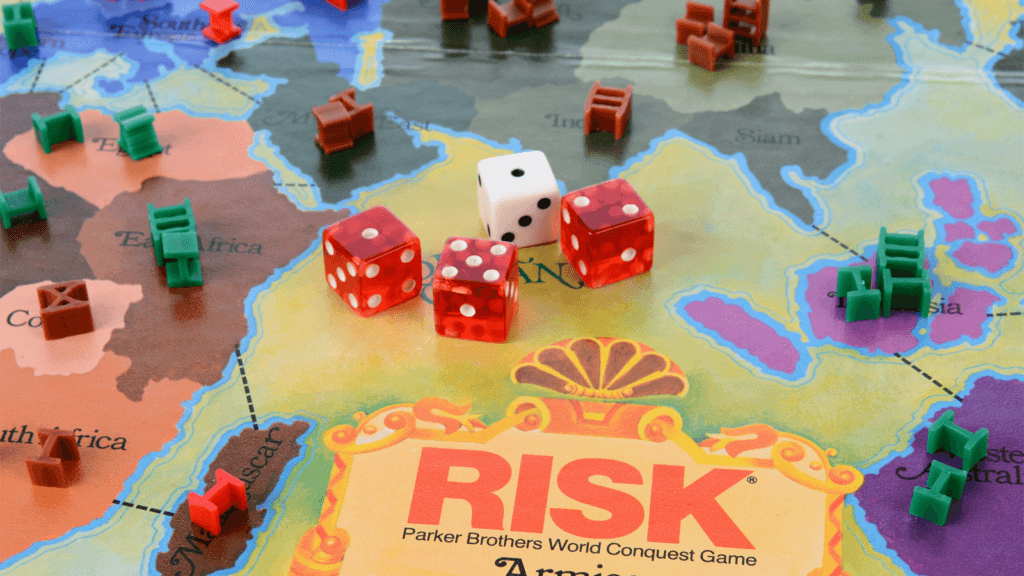
Risk endgames fail for one consistent reason: players slow down when they should speed up. Once you have a clear numerical and territorial advantage, the correct move is to press it aggressively, not consolidate and wait. Every turn you pause, opponents are building armies and cashing cards. The gap closes faster than players expect.
A winning position in Risk is not self-sustaining. You have to finish the game.
If you control two or three continents and hold a significant card hand, plan the sequence of eliminations you need to win and execute it across 2–3 turns. Don’t give remaining players time to form the coalition that makes your advantage irrelevant. The Game Time Hero Risk guide covers endgame sequencing for various board states if you want to work through specific scenarios before your next session.
For players who want to apply similar strategic thinking to other formats, the tactical turn-based strategy games guide covers digital and tabletop titles where territory, sequencing, and resource timing drive outcomes the same way they do in Risk. The probability analysis in MIT’s mathematical analysis of Risk is worth reading if you want to verify the combat odds and card value calculations rather than take them on faith.
Strategygame.org covers the full strategy game landscape across tabletop and digital formats.
The strategy board games worth having in 2026 guide covers what to play alongside Risk as your collection grows. The strategy guides section has tactical breakdowns for other games in the same territory-and-resource tradition. The board game rankings cover broader recommendations by format and play count for groups building out their game shelf.
