
Three things decide a Game Dev Tycoon run: the topic and genre pairing, where you drag the development sliders, and how early you get the R&D Lab open. Everything else is noise. This game dev tycoon guide covers those three in order, plus the late-game money loop that turns a garage studio into a company that prints cash while you watch.
Updated September 2026. Checked against the current Steam build. Game Dev Tycoon is a finished 2013 release rather than a live service, so these systems have been stable for years, which is why advice written in 2016 still mostly works.
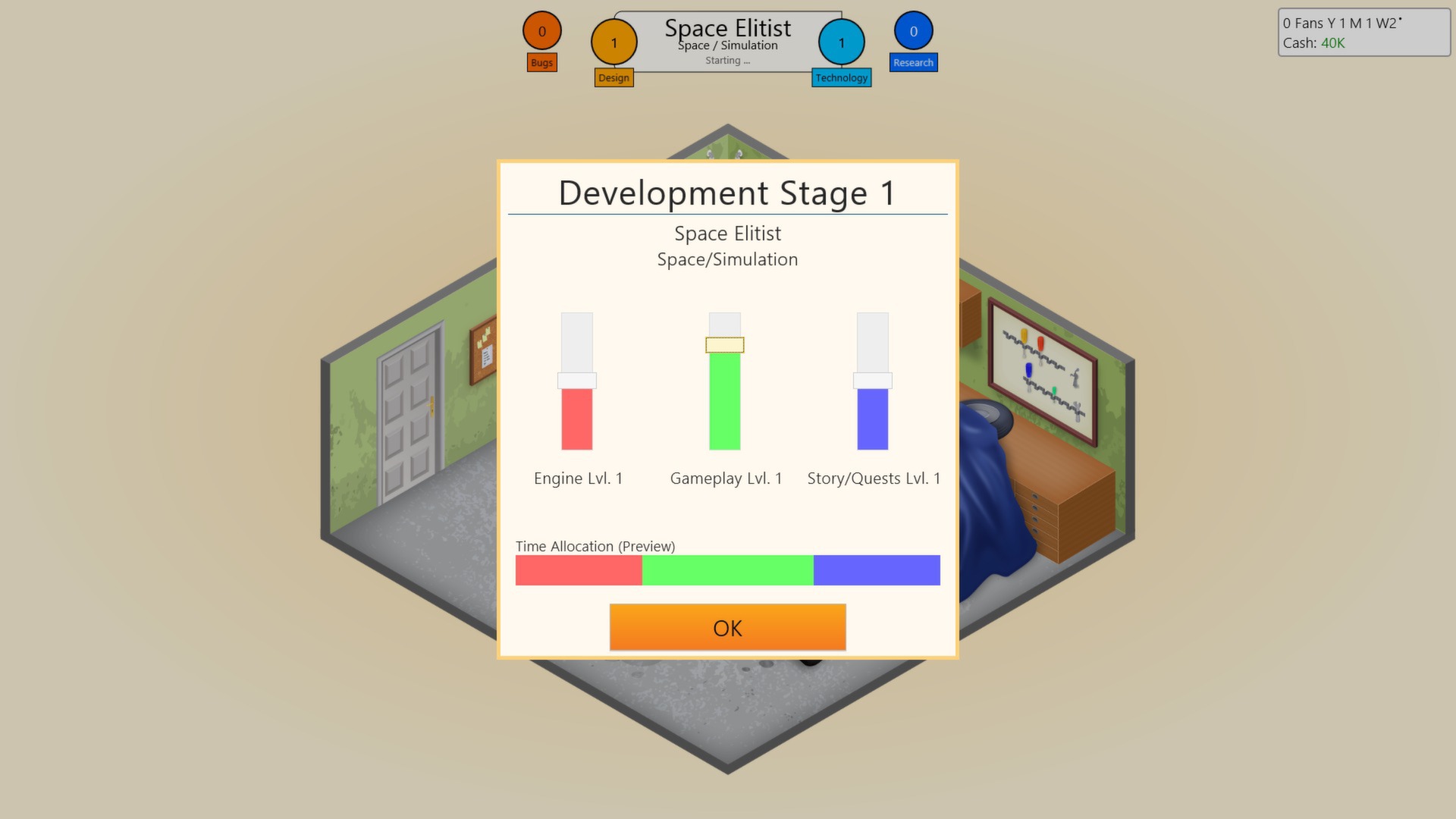
What Actually Decides Your Review Score
Your score comes from four inputs stacked on top of each other: the topic and genre fit, the design-to-technology ratio your slider choices produced, your staff output relative to what the game expects at that point in the timeline, and how recently you shipped something similar. A perfect combo with wrong sliders lands around a 6. Correct sliders with a mediocre combo land around the same place.
That last input is the one people miss. Shipping the same topic and genre pairing back to back drags the score down, so a strategy of finding one great combo and farming it stops working after the second release. Rotate three or four proven pairings instead of hammering one.
Game Dev Tycoon Best Combos, and Why a Great Combo Is Not Enough
The reliable pairings are Fantasy with RPG, Sci-Fi with Action or RPG, Medieval with Strategy or RPG, Dungeon with RPG, and Military with Simulation or Action. Match the audience too: Fantasy and Medieval sit well with Young or Everyone, while Cyberpunk, Vampire and Post Apocalyptic want Mature. Get all three aligned and the game tells you the combo is great before you commit.
Most of what passes for a game development tycoon guide online stops at that table, and the table is accurate as far as it goes. What it leaves out is that a great combo is a multiplier on quality you already produced, not a substitute for it. Bugs left unfixed, a stale engine, and staff who are still generalists in year twelve will hold a great combo at 7 out of 10 forever.
Keep your own notes as you play. The in-game combo hints only appear once you have shipped enough games to learn a pairing, and rediscovering them across saves is the single most tedious part of a second run.
Slider Settings by Genre
Set the sliders to the genre’s weighting and stop improvising. Development runs in three stages with three sliders each, and each genre wants a different split. These are the working numbers, written as percentages of the bar from left to right.
| Genre | Stage 1 | Stage 2 | Stage 3 |
|---|---|---|---|
| Action | 70 / 20 / 10 | 10 / 20 / 70 | 10 / 70 / 20 |
| Adventure | 10 / 40 / 50 | 80 / 10 / 10 | 50 / 20 / 30 |
| RPG | 10 / 40 / 50 | 50 / 40 / 10 | 50 / 40 / 10 |
| Simulation | 70 / 20 / 10 | 10 / 20 / 70 | 10 / 70 / 20 |
| Strategy | 70 / 20 / 10 | 10 / 20 / 70 | 20 / 60 / 20 |

The reason these work is the design-to-technology ratio underneath. Action wants roughly twice as much tech as design. RPG wants the inverse, closer to two parts design for every one part tech. The sliders are the only lever you have on that ratio, so treat the table as a rule rather than a suggestion.
The honest limitation is that the game never shows you a percentage. You are eyeballing bar positions against a table, so treat these as targets to land within a few points of rather than exact settings. Being close is enough. Being wrong by half a bar is what costs you the score.
Research Order for the First Two Offices
Research new genres and topics first, engine features second. Genres widen the number of great combos available to you, and in the garage phase that is the only thing standing between you and a run of mediocre reviews. Topics come cheap and there is no reason to be stingy.
Once you move into the first real office, switch priority to engine parts and build a fresh engine every few releases. Shipping a sequel on the same engine as the original is a direct penalty, and it is the most common self-inflicted wound in the mid game. Multi-genre research is worth taking early too, because a matched primary and secondary genre is a second quality multiplier most players never turn on.
When to Open the R&D Lab and the Hardware Lab
Open the R&D Lab as soon as the game offers it, which happens around 20 million in the bank. It costs 5 million and it is the gate on everything that matters after the second office. Staff it, give the projects a real budget, and do not treat it as an optional side building.
Two projects matter more than the rest. Internet costs 500 research points and opens the path to MMO support. Hardware costs 800 and opens the Hardware Lab, another 5 million building, which is how you eventually ship your own console. Run Internet first unless you are certain you want the console arc, because MMO income arrives sooner and funds everything after it. The community wiki page for the lab lists the full project costs if you want to plan the whole tree.
Where Late-Game Money Comes From
MMOs and their expansion packs, and nothing else comes close. Once MMO support is researched, find a combo the game rates as great, ship it as an MMO, then keep releasing expansions against that same title. Each expansion is cheap relative to a new game and it keeps the parent MMO’s income from decaying, which is the closest thing this game has to a money printer.

Two supporting habits. Train staff into specialists rather than leaving everyone balanced, because AAA titles demand specialists assigned to the heavy stages and refuse to score well without them. And publish yourself once you can afford it, since publisher deals cap your upside in exchange for a safety net you stopped needing around the 20 million mark.
Own consoles are the weakest of the three late-game paths. They cost a fortune to develop and market, and the return only justifies itself if you commit to a long run rather than closing out at the end of the timeline.
What to Do on Your Next Run
If you are starting fresh, spend the garage phase researching genres and shipping small games on cheap topics, take the first office as soon as the money allows, and write down every combo the game confirms. If you are already stuck in the mid game with 7s, the fix is almost always a stale engine or generalist staff, not your combo choices.
One piece of trivia the game has earned: Greenheart shipped a deliberately cracked build of the game in 2013 where the player’s studio slowly went bankrupt from in-game piracy, which remains the best joke any developer has made about DRM. The full story is a better read than most postmortems. The game itself runs $9.99 on Steam and the developer keeps a public changelog going back to launch.
For similar single-game breakdowns, we have done the same treatment for Plague Inc and for age progression in DomiNations. If the industry timeline is the part you enjoy, the real history of the genre lines up with it more closely than you would expect.
It also runs fine on Apple Silicon if that is your machine. If you want the same management itch at settlement scale instead of studio scale, city builders are the neighboring shelf, and the PC side of that genre goes deepest.
Beyond this one, our economic simulation guides and the wider strategy guides cover the rest of the management shelf, and everything else sits on Strategygame.org.
Frequently Asked Questions
What is the best combo in Game Dev Tycoon?
Fantasy paired with RPG is the most reliable one across the whole timeline, with Sci-Fi and Action close behind. Match the audience as well, since Fantasy suits Young or Everyone while Cyberpunk and Post Apocalyptic want Mature.
Why do my games keep scoring 7 out of 10?
Almost always a stale engine or generalist staff rather than a bad combo. Build a new engine every few releases, train people into specialists, and stop shipping the same topic and genre pairing back to back, which carries its own penalty.
When should I open the R&D Lab?
As soon as the game offers it, which lands around 20 million in the bank. It costs 5 million and gates both MMO support and the Hardware Lab, so delaying it delays everything that makes the late game interesting.
What is the fastest way to make money late game?
Research Internet in the R&D Lab, open up MMO support, ship an MMO on a combo the game rates as great, then release expansion packs against it repeatedly. Expansions are cheap and they keep the parent title’s income from decaying.
Is Game Dev Tycoon still worth playing?
Yes for one full run, which takes about twelve hours. The catch is that the combo system is the whole game, so once you know the pairings the replay value drops sharply. Play the first run without a wiki open.
