
Settlers of Catan board game strategy starts before the first dice roll. The player who wins isn’t always the one who traded best or got lucky with the numbers — it’s usually the one who made better decisions in the first five minutes of setup. Opening placement controls your resource flow for the entire game, and getting it wrong is a disadvantage you’ll spend 90 minutes trying to overcome. This guide covers the decisions that actually move the score: where to place your starting settlements, how to read the probability math, when to trade, how to close out once you’re within reach of 10 victory points, and why everyone around the table is playing slightly differently than they think they are.
Why Opening Placement Wins or Loses the Game
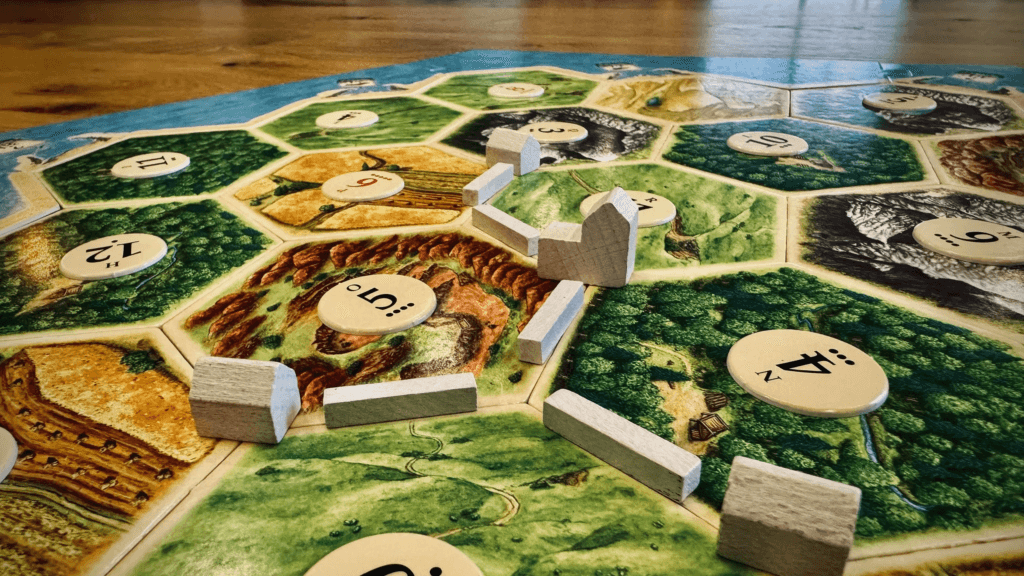
Your two starting settlements determine your resource base for the entire game. Every decision you make afterward — building roads, upgrading to cities, buying development cards — depends on what those settlements produce. Getting placement wrong is the most common reason players finish at 6 or 7 points when the game ends.
The goal is balanced, high-probability production across multiple resource types. Your starting settlements should collectively give you access to Brick, Lumber, Grain, Ore, and Wool — ideally not all at full production, but without being completely locked out of any one type. Missing Ore access means you can’t build cities or buy development cards efficiently. Missing Brick and Lumber means you can’t expand early.
The pip system tells you everything about probability. Each dot under a number represents a 1-in-36 probability of rolling that combination. A 6 or 8 has five pips — it rolls on 5 of 36 possible outcomes. A 5 or 9 has four pips. A 4 or 10 has three. Numbers at the extremes (2 and 12) hit on just one combination each. When evaluating a hex, count the pips: you want your starting settlements covered by high-pip numbers.
Brick is the most contested early resource. There are only three Hills hexes in a standard game compared to four Forest hexes, yet Brick and Lumber are spent at identical rates for roads and settlements. Missing strong Brick access forces expensive port plays or heavy trading dependency from the start.
The Probability Math You Actually Need

The number 7 is the single most probable outcome on any given roll — six different dice combinations produce it. This is the number that triggers the robber, which means the most likely roll in the game is also the one that disrupts production and forces resource discards. Every strategy decision in Catan runs against this backdrop.
Building around 6s and 8s gives you the strongest, most reliable production. The tradeoff is that other players want those hexes too, which drives placement competition toward the best spots early. A 5 or 9 on a resource you control exclusively can outperform a 6 or 8 that you share benefit with through adjacent opponent settlements.
Port access changes the math significantly. A 2:1 port for a resource you overproduce turns surplus into trading flexibility. The 3:1 generic port is weaker than most players assume — spending three of any resource to get one you want is rarely efficient unless you’re overproducing across multiple types. My Kind of Meeple’s placement guide covers port positioning in detail for players who want to think through starting location math before game night.
How to Use the Robber
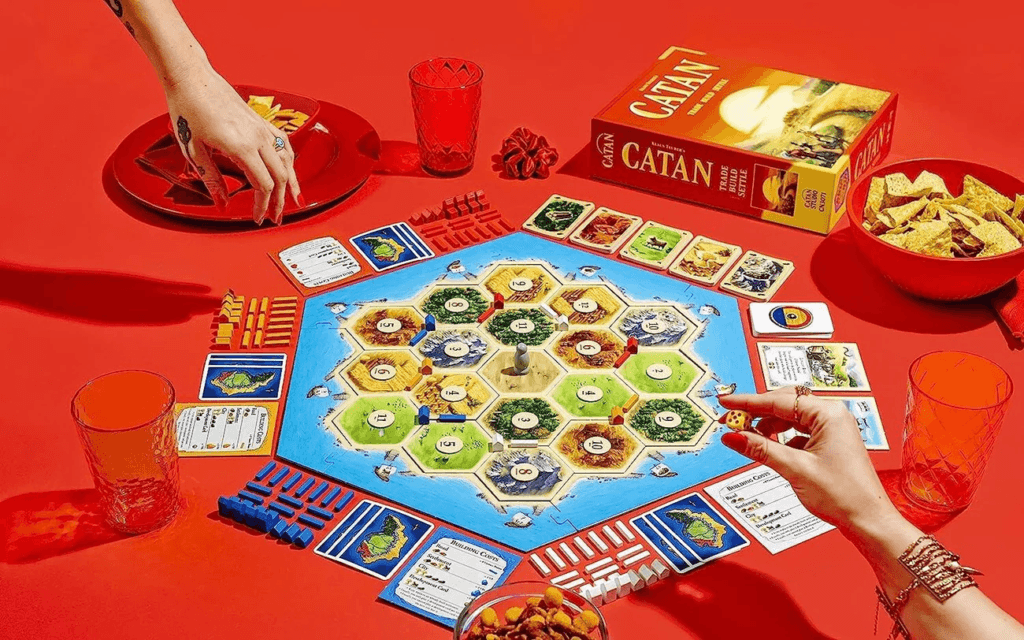
When a 7 rolls, the active player moves the robber to any hex and steals one resource from an adjacent settlement. Players holding eight or more resources at the time of a 7 must discard half their hand, rounded down. Both effects run simultaneously — discards first, then the robber moves.
Most players move the robber onto the resource their opponents need most. The more useful instinct is to place it on the hex that blocks the player closest to winning. Disrupting someone at 5 points is less urgent than blocking someone at 9.
The Knight development card gives you proactive robber control. Playing a Knight moves the robber on your turn, before anyone rolls, on your schedule. Three Knights earns you Largest Army if you’re the first player to hit that threshold — 2 victory points — and each Knight played also repositions the robber away from your strongest hexes if your opponents have been using it against you.
Trade Theory: When to Deal and When to Hold

Trading in Catan is where players give away wins without noticing. Every time you trade resources with another player, you’re helping them build something. Before accepting any trade, ask yourself what the other player is building and whether finishing it brings them closer to winning.
If someone at 8 victory points needs one Grain to place their final settlement, don’t trade them Grain. It doesn’t matter what they’re offering in return. The trade finishes their game.
When you hold a resource someone desperately needs, push the ratio. Trading 1:1 when you have something scarce is leaving value on the table. The bank will trade with anyone at 4:1 — if a player wants your Ore badly enough, they can afford to offer more than parity. Hold at 2:1 or better.
Don’t stockpile resources past 7 cards. Holding 8 or more when a 7 rolls means losing half your hand. Either spend resources before you hit the threshold or accept the exposure as a deliberate choice — never let it happen accidentally.
For players coming to Catan from other competitive board game formats, the tabletop strategy games guide covers titles with comparable resource-management depth across different competitive structures. And for nights when the group wants something with full player asymmetry, the asymmetric strategy board games list has the standout titles in that space.
Longest Road vs. Largest Army
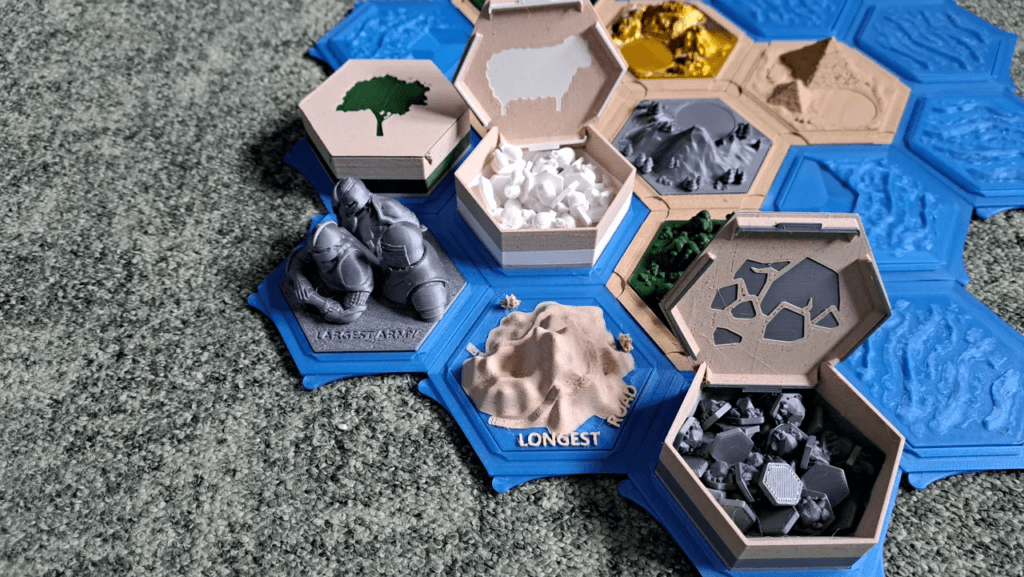
Both special victory cards are worth 2 points. The question is which one your starting resources support and which one your opponents can’t easily steal back.
Longest Road requires 5 connected road segments and goes to whoever extends it furthest. It’s Brick and Lumber heavy, which makes it a natural extension of an early-expansion strategy. The risk: opponents can build a settlement in the middle of your road network to break your connection and claim the card. Build networks that are difficult to interrupt rather than just long straight lines.
Largest Army requires 3 or more Knights played, with the card going to whoever has the most. Development cards cost Grain, Ore, and Wool — the same resources needed to build cities. If your starting position gives you strong Ore and Grain production, Largest Army is the natural secondary goal alongside a city-building path.
The general rule: Brick and Lumber heavy placement points toward Longest Road, roads, and settlements. Ore and Grain heavy placement points toward cities, development cards, and Largest Army. Build toward the special card your resource base already supports rather than trying to force a path your starting settlements can’t efficiently fund. Meeple Mountain’s Catan strategy breakdown covers the six most common ways players misread their resource base and build toward the wrong special card.
Development Card Timing
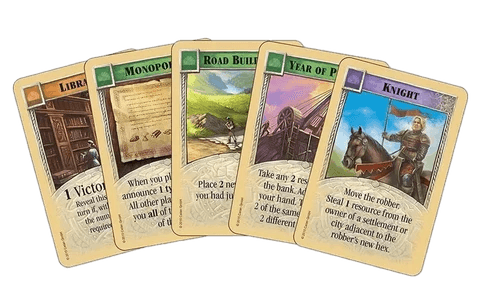
Development cards are the only hidden element in Catan. Once you buy one, the other players don’t know what it is until you play it. That uncertainty is as valuable as the card’s effect.
Knight: Play it when you need to move the robber or when you need one more Knight toward Largest Army. Don’t hold it indefinitely in hopes of a perfect moment.
Monopoly: The most devastating card in the deck when timed correctly. Playing Monopoly on Ore when three players are sitting on 2–3 Ore each can pull 6+ resources in one move. The timing window matters — play it too early and the stockpiles are too small. Wait until the resource you’re targeting has accumulated across multiple players. BoardGameGeek’s Catan page has extensive community discussion on Monopoly timing, card sequencing, and how to read table state before committing a card.
Road Building: Two free roads. Use it when roads are strategically valuable — racing for Longest Road or cutting off an expansion path. Don’t sit on it.
Year of Plenty: Two free resources of your choice. Take what you need to build something this turn. Saving it for a hypothetical future scenario is usually the wrong call.
Closing the Game at 10 Victory Points
Most Catan games slow down at 8 or 9 points. The board is full, resources are contested, and trading dries up because no one wants to help the leader. This is where players lose games they should win.
If you’re within reach of winning, stop announcing what you need. The less other players know about how close you are, the less they’ll coordinate to block you. Don’t ask for the trade that finishes your settlement if everyone can see which spot you’re targeting.
Play Victory Point development cards on the turn you win, not before. They’re hidden until revealed — which means playing them the same turn you place your final settlement can catch opponents off-guard who thought you were at 8 when you were actually at 9.
Keep at least two viable routes to your final point. A player who needs exactly one more city and has no backup path will get robbed on that city hex until time runs out. Maintain optionality into the late game.
Catan is one of the most analyzed games in the strategy board games worth having on your shelf category for a reason. The depth isn’t in the rules — it’s in the reads: who’s about to win, what resources are scarce at the table right now, and whether the trade you’re considering helps you more than it helps someone else.
Catan’s official site maintains the rulebook archive and expansion details for every variant including Seafarers, Cities and Knights, and the Traders and Barbarians expansion.
On Strategygame.org, the strategy guides section covers similar tactical breakdowns for other competitive board games once you’re ready to look beyond Catan.
The adult strategy board games for groups roundup covers titles with comparable depth for groups who’ve mastered Catan and want the next challenge. For families introducing younger players to resource-management games, the strategy games for kids guide has gateway options that build the same reading skills at a lower stakes entry point.
The board game rankings section covers the broader category with picks across formats and player counts for groups still building their shelf.
