
Quick Rundown
Hive is the best two-player abstract for players who want chess complexity without a chess board. Onitama is the easiest entry point: five-minute rules, satisfying depth immediately. Santorini is the most visually approachable and works well with players new to the format. GIPF and YINSH are for dedicated abstract fans who want the genre at its most demanding. All five are pure-information games where luck plays no role.
Abstract strategy board games are the purest form of the strategy genre. No theme, no dice, no hidden information — just two players, complete knowledge of the game state, and the quality of their decisions. The best abstract strategy board games test exactly one thing: how well you think. Strategygame.org covers strategy across every format, and abstract games represent the genre stripped to its core mechanics.
This roundup covers five picks across the abstract spectrum: Hive, Onitama, Santorini, GIPF, and YINSH. Each one tests something different, suits different player counts and experience levels, and occupies a different position on the learning curve. If you already read our coverage of strategy board games broadly, this is the next level down — games where the strategy is the entire product.
What Abstract Strategy Board Games Actually Test
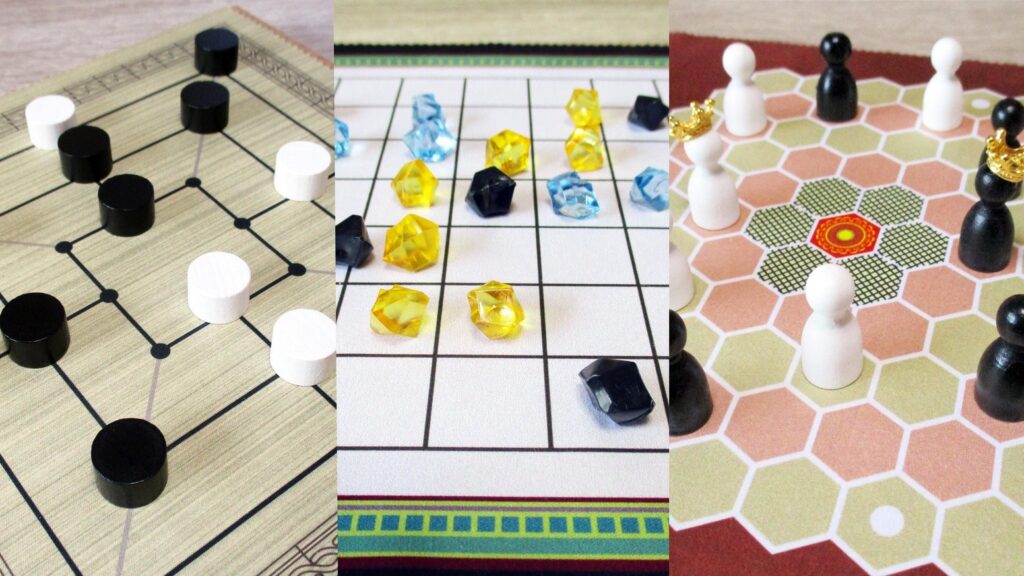
The defining feature of an abstract strategy game is perfect information: both players see everything, know everything, and the only variable is decision quality. Chess is the most famous example. What distinguishes modern abstract design is the move away from chess’s asymmetric opening theory and toward games where balance and accessibility are built into the ruleset from the start.
Good abstract games test spatial reasoning, long-range planning, and the ability to hold multiple threat tracks in mind simultaneously. The same cognitive demand shows up in turn-based strategy games broadly, but in an abstract you get it without the fictional layer. No army management, no resource economy — just the board position and what you choose to do with it.
The Best Abstract Strategy Board Games to Own
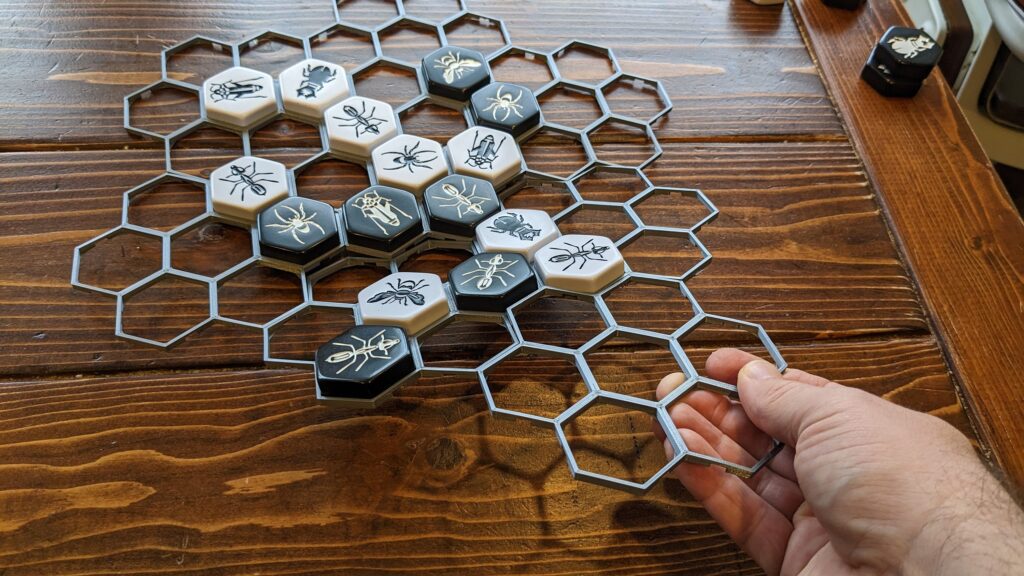
Hive is the most direct answer to “what do I play if I like chess but want something original.” The game uses hexagonal tiles representing insects, each with different movement rules. White and black tiles form a single shared hive that grows as pieces are placed. There is no board: the tiles themselves are the play surface. The goal is to completely surround your opponent’s Queen Bee. It plays in 20 to 30 minutes, handles two players, and comes in a travel-sized pocket edition that fits in a coat pocket. The piece movement rules are distinctive enough to feel like a genuinely new puzzle rather than a chess variant.
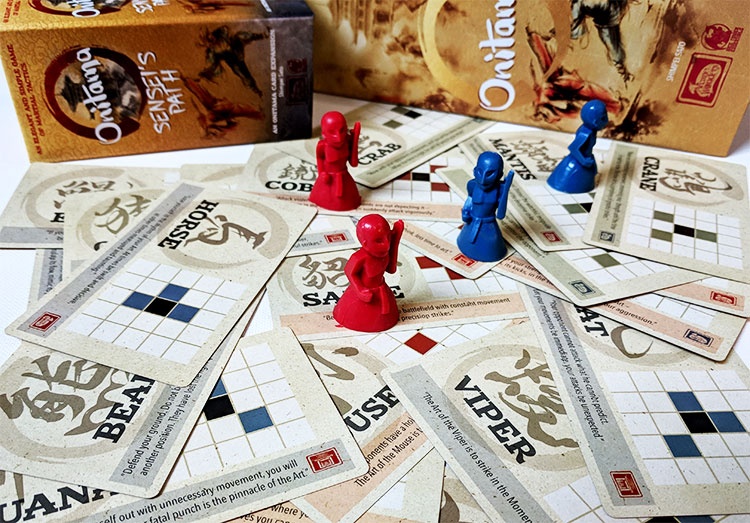
Onitama is the best entry point to the abstract genre for someone who finds chess intimidating. The game uses a 5×5 grid, five pieces per side, and a rotating hand of movement cards drawn from a shared deck. On your turn, you use one of your two cards to move a piece, then pass that card to your opponent. The limited piece set and small board mean the game state is always legible, but the card exchange creates genuine uncertainty about what moves are coming. It teaches in five minutes and produces strategically interesting games immediately. For players who came to strategy gaming through mobile strategy games and want to explore the analog side, Onitama is the right first step.
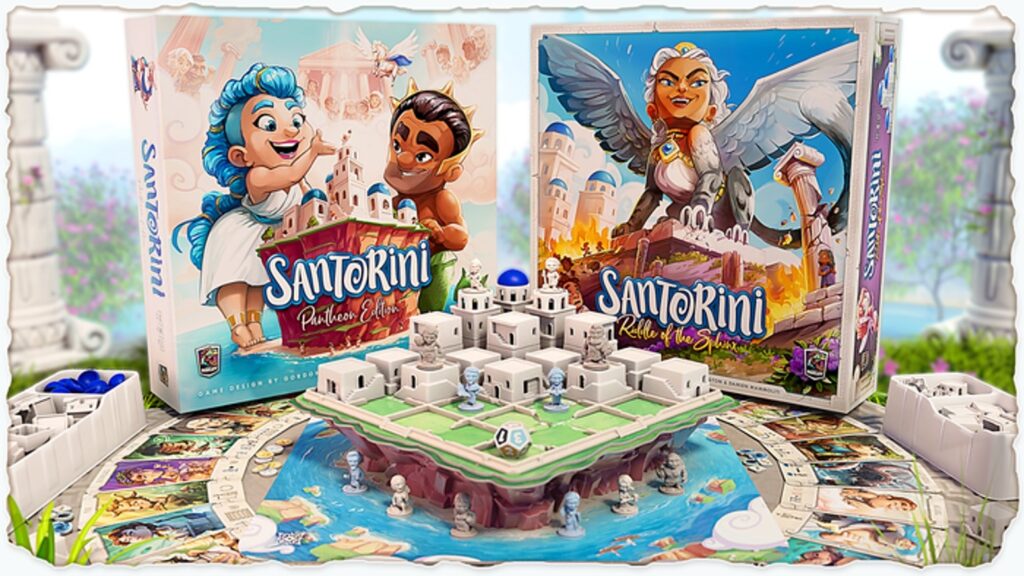
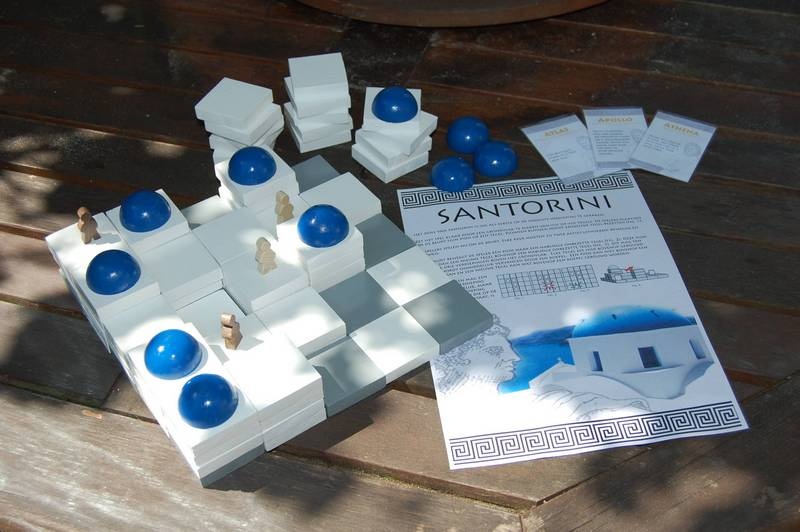
Santorini plays differently from any other abstract on this list. Both players take turns placing workers on a 3D island and building towers, with the goal of moving a worker to the third level of a tower. The three-dimensional movement and building mechanics create a spatial puzzle that feels distinct from the flat-board planning in most abstracts. It also includes asymmetric God cards that grant each player a unique rule-breaking ability, which can be added once the base game is comfortable. Santorini is the most visually appealing abstract on this list and the easiest to get to the table with players who are new to the format. It works at two to four players, though the two-player game is the most strategically precise.
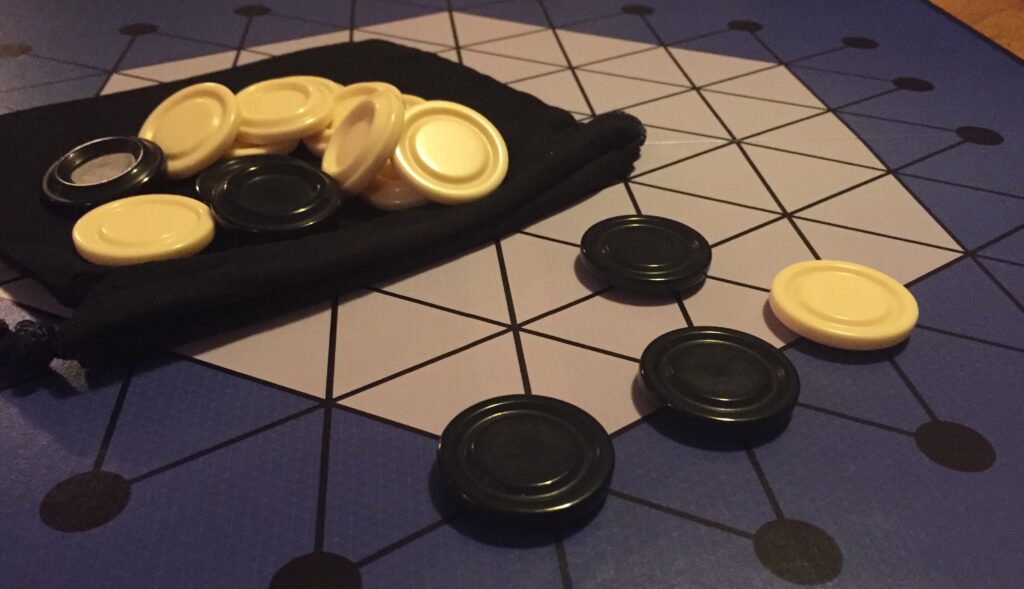
GIPF is the anchor game of the Project GIPF series — a collection of six abstract games designed by Kris Burm, each exploring a different facet of strategy. GIPF itself is a push-and-capture game on a hexagonal board where rows of four matching pieces are removed from play. The layered rules of the series (you can eventually integrate pieces from other GIPF Project games as “potentials”) make it the deepest rabbit hole on this list. For players interested in grand strategy who want an analog equivalent of that depth-per-ruleset ratio, the GIPF Project is the closest thing the abstract genre has. Start with GIPF alone before committing to the series.
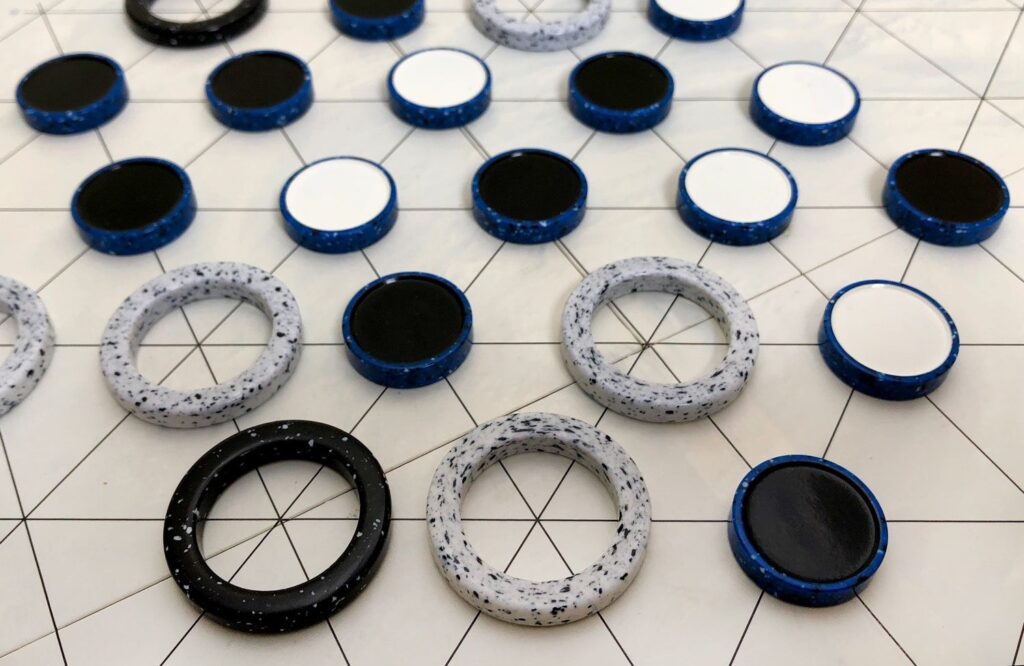
YINSH is consistently ranked as the best game in the GIPF Project and one of the best abstract strategy games ever designed. Players move rings across a hexagonal board, flipping markers as they pass over them. The goal is to line up five markers of your color, but doing so requires removing a ring from the board — which reduces your movement options. The tension between scoring and preserving your range of motion is what makes YINSH exceptional. It plays two players only, runs 30 to 60 minutes, and has no luck element whatsoever. Players who enjoy real-time strategy games for the tactical pressure they generate will find YINSH replicates that same pressure in a slower, more deliberate format.
How Hard Are These to Learn?
The learning curves here are honest. Onitama and Hive both have simple rule sets that fit on one page and start producing interesting games in the first session. Santorini is similarly accessible, though the 3D movement takes a game or two to internalize. GIPF has a moderate learning curve at the base level but rises steeply if you add the Project game integrations. YINSH is harder to learn than it looks: the scoring mechanism and the trade-off between scoring and range are not immediately obvious, and it takes a few games before the strategic layer becomes fully visible.
Player count is also worth noting. Hive, Onitama, and YINSH are strict two-player games. Santorini scales to four. GIPF plays two. If you need a game that works for a group, Santorini is the only option here that fits.
Where to Go From Here
If you want to build a collection that covers the full abstract strategy range, start with Onitama for accessibility, add Hive for a different spatial challenge, then move to YINSH once both feel comfortable. Santorini is a good parallel purchase if you play with groups rather than a dedicated opponent. GIPF rewards players who want to go deep into a single design system.
The strategy game rankings on this site cover the full range of the genre across formats. Abstract games are the most demanding expression of strategy in pure form. For players who want to understand the strategic thinking these games build, our 4X strategy guide covers how that same spatial and long-term planning applies to digital strategy games at a larger scale.