Over the past two decades, the real-time strategy genre has produced no shortage of heavy hitters: StarCraft II, Company of Heroes 2, and more recent contenders like Stormgate and Tempest Rising, just to name a few. Yet ask any veteran of the strategy gaming scene which title set a benchmark that still hasn’t been broken, and the answer rarely lands on any of those names. It lands on a game that was quietly delisted, slowly forgotten, and all but erased from every digital storefront: The Lord of the Rings: The Battle for Middle-earth II.
Released in 2006 by EA Los Angeles, Battle for Middle-earth II (BFME II) might look at first glance like just another movie tie-in cashing in on Peter Jackson’s blockbuster trilogy. But anyone who ever defended the white walls of Minas Tirith, marched the legions of Mordor across the plains of Rohan, or designed their own custom hero to lead an Elven host knows this was something far more ambitious. It was, and arguably still is, one of the great peaks of the RTS genre — and after 20 years, it stands alone on that summit.
A Deceptively Simple RTS Formula That No One Has Successfully Copied
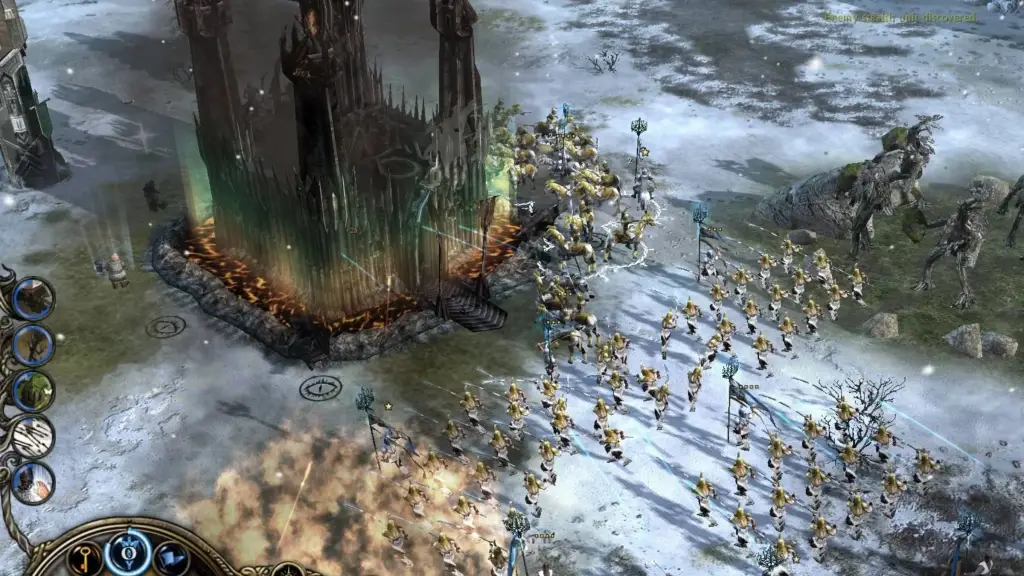
On the surface, BFME II runs on familiar RTS rails from the 2000s: capture resource nodes scattered across the map, build up a base, churn out armies, and crush your opponent. That’s the framework Warcraft III, Age of Empires, and Command & Conquer helped define. What set BFME II apart wasn’t following that formula — it was the way the game bent it to fit the rules of Middle-earth.
Instead of capping armies through the usual “supply” or “food” abstraction, BFME II tied population to command points anchored to your unit-producing structures, forcing you to balance economic expansion against sustained military pressure. The six playable factions — Men of the West, Elves, Dwarves, Mordor, Isengard, and Goblins — each had genuinely distinct tech trees and identities, not the tired “three factions sharing the same template with reskinned units” approach that haunted so many of its peers. Goblins could tunnel beneath the map. Dwarves built fortress walls that turned matches into siege puzzles. Elves leaned on elite archers and nature magic. Each side felt like an entirely different game.
Create-A-Hero — and the Reason No One Has Dared to Revisit It
If one feature explains why BFME II became a legend, it’s the Create-A-Hero system. Players could design a custom hero from scratch: pick a race (Man, Elf, Dwarf, Wizard, Troll, or Orc), customize the look down to armor type and cape color, name them, choose abilities from a generous skill tree, and march that personal creation into both skirmish and online matches.
It was a deceptively bold idea for 2006 — and the strange part is that almost no RTS in the 20 years since has dared to commit to it as fully. Warcraft III had heroes, but they were fixed. Dawn of War offered light hero customization, but limited to a single unit. BFME II, by contrast, let you build something close to a personalized “Avengers roster” and field them alongside icons like Aragorn, Gandalf, and Sauron. It’s a feature so specific to this game that, for many fans, it remains the single biggest reason no successor has ever felt complete.
Dual Campaigns and War of the Ring — A Genuine Strategic Legacy
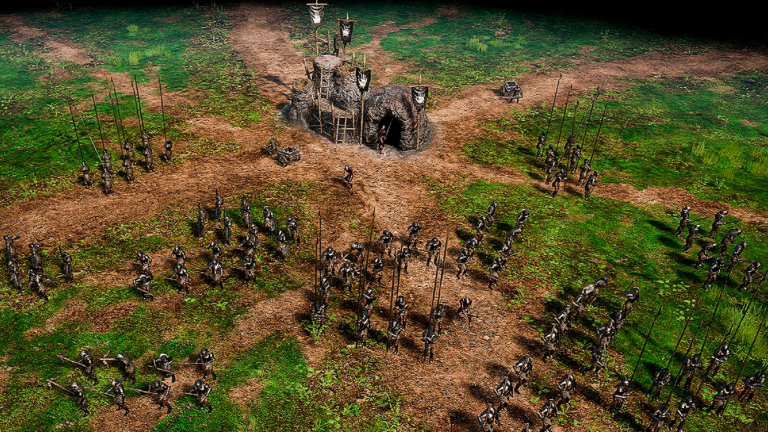
BFME II didn’t just shine in skirmish and multiplayer. It shipped with two parallel campaigns — one for the forces of Good, one for Evil — telling a side story to the films set in the northern reaches of Middle-earth that the books and movies only glossed over. It’s a rare case of a movie tie-in actually expanding its source world rather than just retracing it.
Then there was War of the Ring, a turn-based meta-layer that let players push armies across a map of Middle-earth, capture strongholds, and drop into real-time RTS battles whenever conflicts erupted. This is essentially the formula Total War: Warhammer would later ride to mainstream success — and BFME II was doing it in 2006, years before hybrid strategy became a recognized subgenre. If you’re curious how this kind of layered design has evolved since, our strategy game rankings break down where modern hybrid RTS titles stand against this benchmark.
Why You Almost Can’t Play BFME II in 2026
This is where the story turns bittersweet. As of 2026, if you try to buy The Battle for Middle-earth II legitimately on Steam, GOG, or the EA App, you simply won’t find it. The entire BFME series was pulled from digital storefronts back in 2010, after the licensing agreement between EA and Middle-earth Enterprises lapsed and was never renewed.
The community has done what the publishers wouldn’t: it has kept the game alive. Long-running mod projects like the Edain Mod and Battle for Middle-earth: Reforged are still being actively developed, and community multiplayer services like T3A:Online have kept lobbies populated for over a decade. But to actually play, you’ll need to track down an original install — usually from an old DVD copy or a less-than-official source — and then wrestle with patches and compatibility on modern operating systems. It’s a labor of love, not a casual purchase.
So Why Hasn’t Anyone Built a Successor?
The obvious question: why has such an influential RTS never inspired a worthy heir? Part of the answer lies in the broader decline of the RTS genre throughout the 2010s. As MOBAs exploded with League of Legends and Dota 2, major publishers quietly walked away from pure RTS. EA shuttered Westwood. Microsoft put Age of Empires into hibernation for nearly a decade. Blizzard pivoted toward Hearthstone and Overwatch. The window for a “BFME III” closed alongside an entire generation of dedicated RTS studios.
But there’s a deeper reason too: the risk is enormous. Designing an RTS with six genuinely different factions, deep hero customization, dual campaigns, and a meta-layer like War of the Ring is a colossal scope of work that today’s market struggles to absorb at AAA pricing. When even more conservative RTS revivals like Stormgate and Homeworld 3 are fighting to find footing, taking a swing at something as ambitious as BFME II reads less like a project and more like a gamble.
A Forgotten Monument
The Battle for Middle-earth II isn’t usually the first name dropped when people list the all-time great strategy games. It doesn’t have the esports presence of StarCraft II or the cultural footprint of Age of Empires II. But for those who played it, BFME II is a quiet measuring stick — a standard the RTS genre has yet to revisit.
Twenty years is a long time in this industry. Long enough for three new console generations. Long enough for Unreal Engine to leap from version 3 to 5. Long enough for VR to go from novelty to everyday product. And still not long enough for anyone to make a better Middle-earth RTS than the one EA Los Angeles shipped in 2006. That’s both a tribute to BFME II and an uncomfortable question for the modern strategy genre.
